
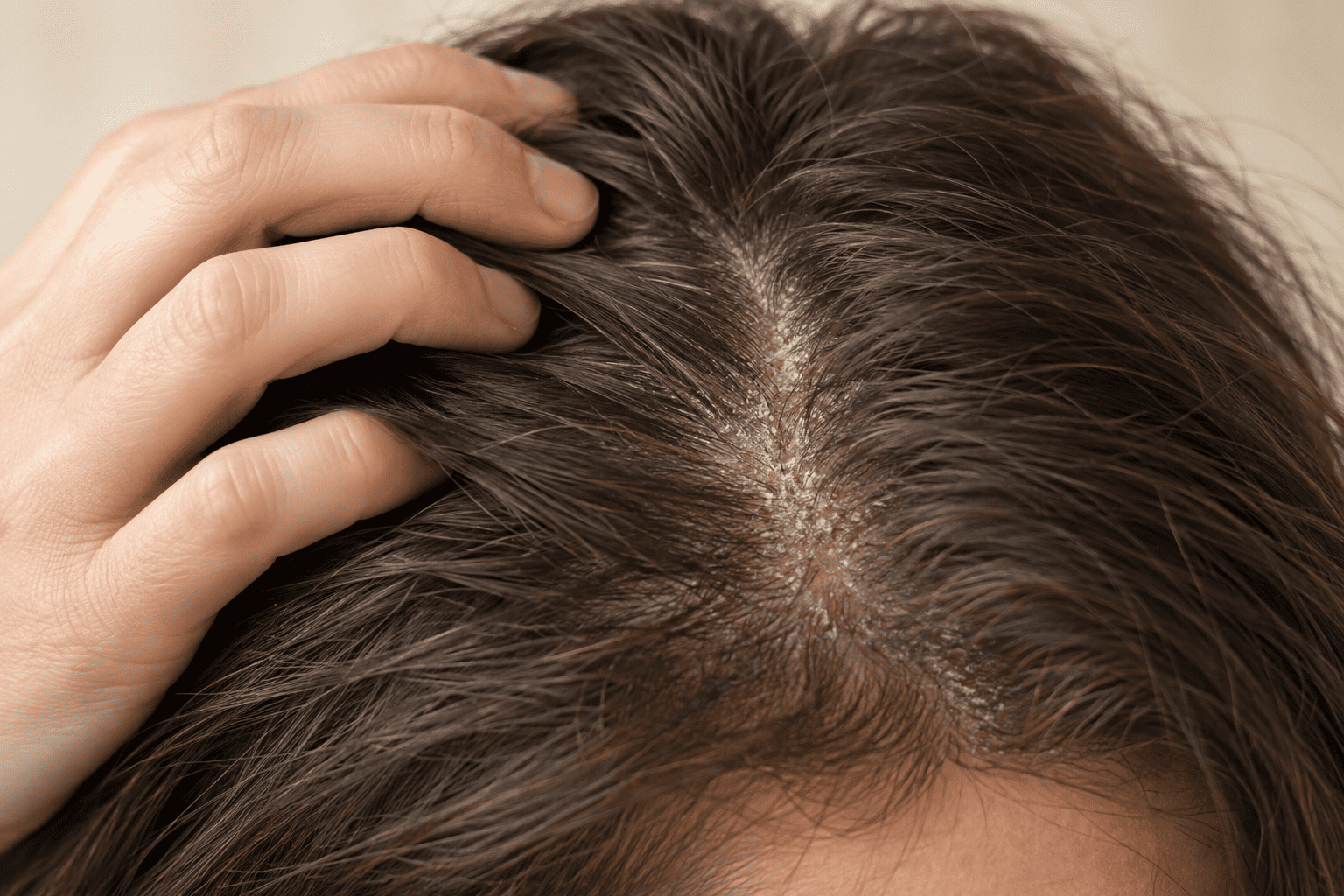
If flakes and itching return soon after changing shampoo, washing habits may not fully explain the problem. Understanding the cause means looking at the scalp, how long the symptoms have been present and whether other areas, such as the eyebrows or skin around the ears, are affected.
Dandruff is considered a mild form of seborrheic dermatitis without visible inflammation. More noticeable inflammation, discomfort and scaling call for a broader assessment. Flakes alone cannot establish a diagnosis: several scalp conditions can look similar.
How dandruff and seborrheic dermatitis are connected
Mild dandruff commonly produces fine, pale flakes scattered across the scalp, sometimes with a little itching and no obvious underlying redness. More inflamed seborrheic dermatitis can bring redness, tenderness and greasy or yellowish scale. Scale that looks dry does not rule it out.
Similar patches around the eyebrows, sides of the nose, ears or beard can offer useful clues. In darker skin, inflammation may appear as areas that are lighter or darker than the surrounding skin rather than bright redness. The distribution and course of the symptoms matter as much as the appearance of the flakes.
Why flaking keeps returning
Seborrheic dermatitis involves an interaction between Malassezia yeasts that normally live on the skin, skin oils and an individual inflammatory response. Differences in the skin barrier may also contribute. The exact cause is not fully understood, and an oily scalp does not mean that someone will necessarily develop the condition.
Dandruff and seborrheic dermatitis are not signs of poor hygiene and are not contagious. Stress and cold, dry weather can trigger flares in some people. Hot water, harsh cleansing and irritating hair products can also make symptoms worse. Noticing a pattern can be more useful than repeatedly adding new products.
Other conditions that can resemble dandruff
An examination helps distinguish overlapping causes of an itchy, flaky scalp. Certain features can change what needs to be investigated:
Scalp psoriasis may cause thicker, more clearly defined plaques that extend beyond the hairline. Features of psoriasis and seborrheic dermatitis can also overlap.
Contact dermatitis may cause itching, burning or irritated skin after exposure to hair dye, shampoo or styling products. Timing is a useful clue, but does not prove an allergy.
Scalp ringworm can cause broken hairs, patchy hair loss or painful swelling alongside scale. These symptoms need medical assessment rather than further trials of dandruff shampoo.
Scalp care that can help
For mild dandruff, a suitable cleansing routine and an anti-dandruff product may help. A pharmacist or dermatologist can advise on selection and use. Ingredients and directions vary, so there is no single washing schedule that suits every scalp and hair type.
Apply dandruff shampoo to the scalp. Follow the label or your clinician’s instructions for contact time and frequency; leaving it on longer is not necessarily better.
Use lukewarm water, wash gently with your fingertips and rinse thoroughly. Scratching off scale or scrubbing vigorously can increase irritation.
Curly, dry or chemically treated hair may need a different routine. Dry hair lengths and a flaky scalp are separate care concerns.
Stop a product and seek advice if it causes marked burning, redness or worsening symptoms. Introducing several products together makes it harder to identify an irritant.
How treatment is tailored
Treatment aims to ease itching and scaling, control inflammation and reduce flares. Depending on the findings, a dermatologist may recommend products that target yeast, help loosen scale or reduce inflammation. The choice, application site and duration depend on the individual.
A product prescribed for the scalp may not be suitable for the face. A clinician should determine whether a steroid product is needed and how long it should be used. Maintenance care may be needed after symptoms settle. A flare does not, by itself, mean the original treatment was wrong or that the shampoo has stopped working altogether.
When to see a dermatologist
Arrange an assessment if an anti-dandruff product used as directed has not helped after about a month, or if symptoms keep returning. You do not need to wait that long if itching disrupts sleep or daily life, the scalp is noticeably inflamed, or the face and ears are also affected.
Pain, oozing, pus-filled bumps, marked swelling or new patches of hair loss need prompt medical attention. Seek same-day care if rapidly spreading redness is accompanied by fever or feeling unwell. These changes should not be assumed to be an ordinary part of dandruff.
Preparing for an appointment
Note when symptoms began, which products you use, what has helped before and whether other areas of skin are involved. Photographs taken during a flare may also be useful. A diagnosis can often be made from the history and examination; additional testing is considered when a fungal infection or another condition is suspected.
The clinic’s information on hair and scalp conditions explains the scope of assessment. For recurring flaking and itching, a treatment plan starts with understanding the full pattern of scalp symptoms.
Frequently asked questions
Does washing my hair every day make dandruff worse?
Not necessarily. Oiliness, hair texture and the product used all matter. Choose a routine that does not irritate the scalp, and follow the specific directions for any treatment shampoo.
Can seborrheic dermatitis cause hair loss?
Noticeable or patchy hair loss should not automatically be attributed to seborrheic dermatitis. Broken hairs, bare patches or increasing shedding alongside scale warrant an assessment for other causes.
Can dandruff come back after it clears?
Yes. Adult seborrheic dermatitis can alternate between flares and quieter periods. Appropriate care and maintenance treatment, when needed, can help control symptoms, but cannot guarantee they will never return.
Is this advice suitable for children?
This article concerns adult scalps. Cradle cap in babies and scalp flaking in children need a separate approach. Do not apply adult dandruff products to a child without appropriate advice.
This article provides general information and does not replace an individual medical diagnosis or treatment plan.
